

Snake keeping has been around for a long time. However, as we continue to learn more about the animals we keep, we’re starting to understand the signs of physiological and psychological stress in them that were otherwise dismissed. Snakes can be difficult to read in comparison to mammals or birds, and as a result of this in the past they were labeled as “dull” or “purely instinctual”. There is in fact more going on in their brains, and there are physical signs that can clue us in to just how they’re feeling.
*
*
*
Reading Body Language
Snakes and most reptiles don’t possess facial muscles that signify expressions. Humans have 42 facial muscles due to our evolutionary history as a social species that relies on visual cues for communication. Snakes aren’t typically social, leading solitary lives hunting and only meeting others of their kind to breed or defend territory. Instead of expressions, snakes use pheromones, body posturing, and hissing to communicate to other animals.
When keeping them in captivity, we want to look for signs of stress that can clue us in on how the snake is feeling or even what they might be thinking.
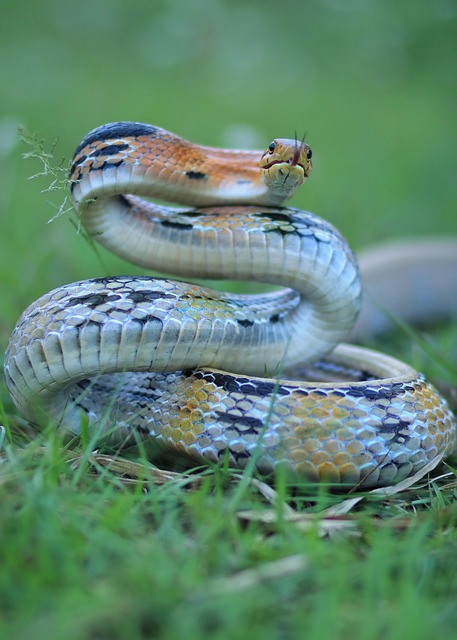
- The S Position – Holding their head and neck in an S position means they are readying for a strike. They generally do this before being fed, but can hold this position during a confrontation with something they see as a potential threat. Context will matter with this posture.
- Freezing – A snake will completely stop all movement and stay put. This is when they shut down, but they are generally very scared when they do this. No tongue flicking happens during this time.
- Retreating/ Fleeing – When the snake chooses to get away from the stimulus and retreat into a safer place. They may do this slowly, or quickly depending on how afraid they are. If they are this scared, let them retreat.
- Striking – This is what a snake will do when they are absolutely terrified and feel like they’ve run out of options. Most snakes just want to flee if they’re afraid. Hey do this as a last resort.
Flooding an animal with stimulus (handling, feeding, enrichment, etc.) when they are not ready is no way to help an animal break through it’s fear. It can shut them down completely, and if done enough, the animal just gives up having its own will. Nothing should have to live like that.
*
*
*
Respect & Consideration
When I stumbled upon Lori Torini’s Youtube channel, I binged her videos to learn how to better my understanding of my snakes and how to improve their lives with me. Snakes aren’t domestic animals, so they have no inclination to do anything that pleases us like dogs or cats do. However, that doesn’t mean they can’t make choices of their own to experience different things in their environment.
Lori has videos on habituating snakes to target training, and shifting. Target training has been utilized in zoos for years with multiple reptile species, and snakes can learn inside the keepers’ homes, too. Target training can help get an animal familiar at recognizing feeding times and distinguish between that and non-feeding interactions. This can really help with snakes that have a really aggressive feeding response.
Shifting is when a snake chooses to move from one place to the next. In this case, Lori has a mobile stand made from PVC and other materials that she’ll move near an enclosure, and the snake will sometimes choose to come out on the stand. Then Lori can move the stand to another location where the snake may have access to other areas to explore. In one area, there is a box where one snake, specifically a bull snake, will station inside and wait there to be taken back to her enclosure.
When snakes are given these choices, they are very capable of communicating their wants and needs with their keepers. Instead of grabbing a snake out of its enclosure without regard to its choices or comfort, we as keepers can give them agency in their own lives. Being a pet, or even being born in captivity, was never their choice. Many choices have already been taken from them and many other animals, so the least we can do is approach them with furthered understanding and consideration. By doing this we can reduce stress and improve our relationships with them.
I know many people don’t believe one can establish a relationship with snakes. I’m here to tell you that’s wrong. While they may never express affection or love like a fellow mammal, earning their trust and building their confidence goes a long way. They will come out of their shells and make choices to be near you, and appreciate the positive interactions you have together. When others have waved away their need for agency, you gave them something they could trust and familiarize with without fear.
*
*
*
My Snakes
My own snakes are two female Ball Pythons who were in previous homes where they were no longer wanted. I adopted them from a friend who took them in temporarily. Neither of them sport fancy expensive color morphs, and I’ve never been interested in that anyway. I simply love the animals themselves and wanted to give them a home.

Mara – 5 Year Old Ball Python
Mara was already fairly outgoing when I brought her home at 3 ½ years old. Every night like clockwork she’d come out and surf at the front of the glass to be let out. She never liked hands to go near her head and would bulk away if I got too close. She also never used to strike prey when fed. I had to just lay it down inside her enclosure and eventually, she’d come get it when she was ready.
While I didn’t know anything about choice-based handling techniques during this time, I always liked to leave the door open for her to make her own choice to come out or not. Once she had two thirds of her body out, I could pick her up or set her somewhere she could explore.
After a year or so with me, Mara now strikes her food and seems to have built more confidence than when she first came home. She really is more self assured in her movements and the things she chooses to explore.

Isha – 2 Year Old Ball Python
Isha came from a heartbreaking situation and admittedly, I wanted to take her in almost immediately. I’d never seen a baby Ball Python so scared of hands and of being handled. Her previous owner was a college student who was accidentally bit during feeding. Any python owner can tell you, with those heat sensing pits your hand is warm enough to look like food. Maybe the prey item wasn’t warm enough, and she locked onto the hand. Bottom line, this young snake made a mistake. After that point, the college student was terrified of her and from the way this snake reacted with hands, I have a feeling she may have been abused.
After watching Lori Torini’s videos on choice based handling, I kept a hands-off approach with Isha for a year. I only ever picked her up gently during enclosure cleaning or to do overall body checks. Eventually, I started sitting in front of her enclosure when she would poke her head out of her hide to see what was going on, and place my hand at the edge of the open door for her to come investigate if she wanted to. Little by little, she’d inch out to tongue flick me and then retract back in the hide. That went on for a few months.
A few months ago, she started coming out toward the front of the enclosure doors, just sitting, or sometimes moving about like she wanted to come out. Whenever she did this, I’d open the door to give her an opportunity to come out. The first few times, she just froze and then retreated into a hide. For the first time ever, she actually climbed all the way out and crawled all around my empty shoes just below the shelf. I was able to pick her up without a negative reaction and place her back in her enclosure after 15 or so minutes. On following jaunts out, I set up a playpen for her to explore in. She must’ve been in there an hour or so until I unzipped the opening and she came back out to be put away again.
That was a huge milestone for a previously fearful snake. Almost every young snake knows everything else could eat it, so they are already on edge. To overcome that fear, especially after a human has mistreated it, takes a lot of patience for them to really be convinced. The one thing Isha’s fear never dulled was her appetite. She has always eaten well, just like a heat-seeking missile.
I hope I gave some insight into choice-based handling for snakes, and I encourage others to follow and watch Lori’s videos if you own snakes, or are planning to. Drop a line in the comments if you have any experience with using handling techniques like this.
 Art of Angela DeRiso
Leave a comment